Benefits to the Watershed and Its Inhabitants
--By Keith Hammer - 1994
This article examines the benefits derived from obliterating roads already constructed in our National Forests. Many National Forests, including the Flathead, have come to recognize the need to obliterate many roads in order to restore watershed health and to re-secure habitat for the many species which live there. Scientific research, pilot programs and a growing public awareness are rapidly demonstrating the need to obliterate roads rather than simply gating them to motorized travel.
The Dilemma
The public controversy surrounding both the construction and closure of Forest Service roads is not a new one. Senator Dale Bumpers captured the dilemma in his comments during passage of the National Forest Management in 1976:
Unfortunately, the building of permanent roads in many areas has created new problems by encouraging uncontrolled access to remote, lightly patrolled forest areas with an attendant increase in litter, vandalism, fire danger, and an increased encroachment on the solitude which these areas once offered the hunter, the fisherman, the hiker, and the naturalist. Nor is simply closing off such roads, once they are constructed, an adequate remedy. Local people justifiably find it difficult to understand why they should be denied the use of a road built with their own tax monies.
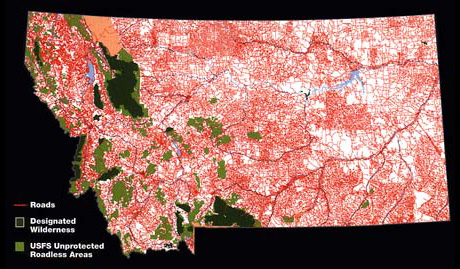
The National Forest Management Act consequently encouraged the use of lower standard, temporary roads and included a requirement that the Forest Service revegetate within ten years all roads not needed on a permanent basis. The Forest Service, however, continued to construct predominently high standard roads and close only some of them with gates and signs which read "Road Closed - Administrative Use Only". Many roads no longer needed for timber harvest were simply forgotten, rather than obliterated, and allowed to receive continued human use. We now have over 350,000 miles of roads in our National Forests. Nearly 4,000 of those were constructed on the Flathead National Forest. True to Senator Bumpers' prophecy, a lot of people have become accustomed to using many of these roads and are resistant to their being closed, especially when the Forest Service continues to use the closed roads itself. To many, this simply does not seem fair.
To Gate or Obliterate
 Studies conducted on the Flathead and Kootenai National Forests show that gates simply are not effective in preventing motorized travel on closed roads. Many gates are simply left unlocked, are driven around, or are winched out. As already mentioned, the area behind a gate is not secure because the Forest Service (or anyone else with a key) routinely drives behind the gate. Moreover, a gated road still serves as a trail for foot, horse, bike and off-road-vehicle traffic.
Unless a road is fully obliterated, it is bound to continue receiving human use and fail to fully revegetate. A study on the Flathead National Forest found that the Forest Service inventory of its temporary roads accounted for only 30% of those temporary roads still in existence and useable by cars and trucks. The same study found that the Forest Service inventory accounted for only 2% of the trails resulting from old roads still wide enough for off-road-vehicle use. The Forest Service itself estimates that there is a mile of uninventoried road for every four miles of inventoried road in northern spotted owl habitat.
These facts and common sense show clearly that a road will not cease functioning as a road or trail until it is fully obliterated to the point where travel off of the former roadbed is easier than travel on it. As the following discussion on the benefits of road obliteration will show, simply gating a road or taking it off of the inventory does not make the impacts or the road go away.
Road Obliteration: Benefits to the Watershed
An evaluation of a pilot road and watershed rehabilitation program in Redwood National Park shows roads to be the biggest culprit in the watershed:
Because roads are the single most persistent, preventable, and often the largest source of slope erosion and downstream disturbance, the most effective proactive intervention that has been widely identified is obliteration or relocation of road systems and reestablishment of natural drainage systems.
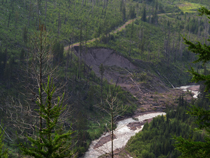
 Indeed, in northwestern Montana, 80-90% of the sediment produced by logging and road construction generally is attributable directly to the road. The Flathead National Forest estimates that on one of its most pervasive and sensitive land types, one mile of road produces 98 tons of sediment, 80% of which reaches the stream bed.
When a road is cut across a hillside, it often intercepts subsurface water flow and runs it down ditches and through culverts. There it picks up sediment and is joined by sediment-laden runoff from the roadbed and cut banks before running into a stream. Hence, subsurface water which would have once welled up to clean bull trout spawning gravels now carries sediment from the surface and deposits it onto the spawning gravels, where it smothers the eggs and fry.
Surveys conducted by the Bitterroot National Forest show that its few surviving bull trout populations are located in watersheds with the least roads, stream crossings and timber harvest. Bull trout are absent in watersheds with the most roads, stream crossings and timber harvest.
Roads, including those behind gates and dropped from inventories, continue to produce sediment until they are totally revegetated. Proper road obliteration, which returns the road bed and fill slope to the contours of the land and replaces culverts with natural stream channels, offers our best opportunity to restore health to our heavily roaded watersheds and the fisheries they support.
Benefits to Other Watershed Inhabitants
Obviously, sediment sensitive westslope cutthroat trout benefit from road obliteration in the same way that bull trout do. There are many species of wildlife, however, which also benefit from the obliteration of roads.

Recent grizzly bear research conducted on the Flathead National Forest shows that grizzly bears avoid closed roads as well as open roads. As a result, total road density is now viewed as importantly as open road density in making management decisions. The need to obliterate roads in order to reduce total road densities has finally been acknowledged. Initial applications of these research findings have resulted in estimates by the Flathead National Forest that about one-half of its roads in grizzly bear habitat may have to be obliterated. The Interagency Grizzly Bear Committee is currently reviewing the standards for applying this research.
Elk, like grizzly bears, also avoid roads. Research has shown that even very low levels of traffic, like the administrative use allowed behind gates, keeps elk from using the roaded area. Both elk and grizzly bear researchers have postulated that, once the species learns to avoid an area, it may take entire generations after the road is closed before the learned avoidance behavior is lost and the area becomes effective habitat once again.
Wolves, like grizzly bear and virtually every other species of wildlife and plant life, suffer from increased mortality as a result of human access via roads. Studies have shown that, when open road densities exceed 0.9 miles per sqare mile, wolves simply fail to survive there.
Benefits to All Species
 Opponents of road closures and obliteration often try to pin the blame on a single species, be it a spotted owl or a grizzly bear. In fact, however, road obliteration benefits all the species native to the ecosystem and watershed. On vast areas of the Flathead National Forest, for example, a road obliterated to benefit water quality and bull trout will likely also benefit westslope cutthroat trout, elk, wolf, pileated woodpecker and grizzly bear.
Simply put, the ecosystem begins to unravel the moment a road is built and cannot sustain itself when there are too many roads. Road obliterations are the sutures by which we begin to mend the ecosystem.
Benefits to Humans Too
Road obliteration benefits the human spirit by returning a bit of solitude to areas once pristine and roadless. This solitude and security has also been shown to improve the sport hunting of big game species such as elk by maintaining more antlered bulls than can be maintained in areas of easier human access.
Road obliteration makes good economic sense as well. Even though gated, closed roads still cost the Forest Service and the taxpayer about $65 per mile per year to maintain. Properly obliterated roads cost nothing to maintain and their closure is fairer to everyone because no one gets special privileges behind a gate.