Road Closure Gates Cannot Effectively Eliminate Trespass
For more than a decade, land and wildlife management agencies have recognized that gates are largely ineffective in stopping motorized use of forest roads to provide wildlife security. In spite of concerted attempts to make gates effectively eliminate trespass by the public, a recent survey of Forest Supervisors in the Northern Continental Divide Grizzly Bear Ecosystem shows continued widespread failure.
(Read Full Article)
A short history of sawmills and other industry along Mill Creek in the Flathead Valley, including the town of Jessup
--By Keith Hammer and Debbie Sanders. Republished October 2001.

(Read Full Article)
 An Assessment of Integrated Road and Culvert Management on the Flathead National Forest
--A 14-page report by Keith Hammer. December 2000.
(Read Full Article)
A one-page, poster-format photographic summary of Forest Service misrepresentations of the Bitterroot's historic ponderosa pine forests.

U. S. Forest Service Misrepresenting the Historic Condition of Western Forests and the Effects of Fire Suppression and Logging.
An 8-page report by Keith Hammer. August 2000, revised December 2001. This report is available in pdf format (646k) and the photos it utilizes are also available individually in high-resolution jpeg format. Ponderosa-Poster-Child.pdf
Our one-page poster, "Text, Lies and Photographs" summarizes Forest Service misrepresentations of the Bitterroot's historic ponderosa pine forests and is available as a pdf file (96k pdf). PPine-Poster.pdf

Lick Creek Poster (820k high res version): "USFS Poster: 88 Years of Change in Ponderosa Pine Forest."
High resolution images of pertinent Forest Service photos can be viewed or downloaded by viewing the full article:
(Read Full Article)
Benefits to the Watershed and Its Inhabitants
--By Keith Hammer - 1994
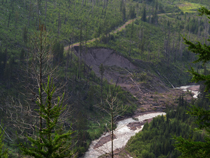
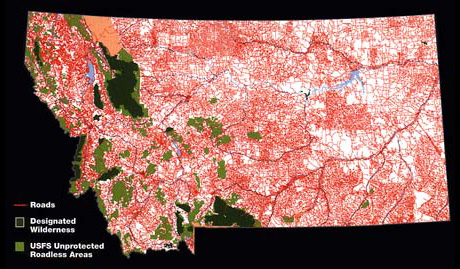
This article examines the benefits derived from obliterating roads already constructed in our National Forests. Many National Forests, including the Flathead, have come to recognize the need to obliterate many roads in order to restore watershed health and to re-secure habitat for the many species which live there. Scientific research, pilot programs and a growing public awareness are rapidly demonstrating the need to obliterate roads rather than simply gating them to motorized travel.
(Read Full Article)
 It is destructive enough when the U.S. Forest Service builds roads into critical wildlife habitat in order to cut down the forest and haul away the logs. It adds insult to injury when the logging roads are built even though timber companies refused to bid on the trees the Forest Service wished to sell!
This booklet will look at two environmentally destructive road projects on the Flathead National Forest of Northwest Montana. In the cases of Bent Flat and Sunset Beaver, the Forest Service did not receive a single bid on either timber sale in the 1980's, but went ahead and spent $840,000 of "hard money" (your tax dollars appropriated by Congress) to build 27 miles of new road and reconstruct 14 miles of existing road in the timber sale areas. Now the Forest Service acknowledges that the timber sale environmental documents on which the road construction was based are insufficient for the timber sales to proceed!
This scenario is common. When timber buyers balk at paying the price for federal timber and road construction, the Forest Service simply uses your "hard money" tax dollars to build the roads for them. It provides this subsidy in an attempt to lure the timber industry into remote and steep roadless lands where the costs of building the roads and conducting the timber sale often exceed the market value of the trees. This is an environmentally destructive and economically foolish practice which you can help stop!
 Road closure structures within Grizzly Bear Management Situation One areas of the Swan Lake Ranger District were ground truthed. 38% of the closures truthed were found to be ineffective in fully restricting passenger type vehicles. The road miles behind these ineffective closures comprises 44% of road reported by the USFS as being closed year-long to all motorized vehicles, and from April 1 to November 30 to snowmobiles, in order to protect wildlife resources.
Hammer_1986_Road_Closure_Effectiveness.pdf
(Read Full Article)
Page: ←1234